
May your Christmas be filled with peace, joy and love.
Have a Blessed Christmas!
According to McKinsey’s report ‘What’s
next for remote work: An analysis of 2,000 tasks, 800 jobs, and nine countries
(November 2020)’, the potential for remote work is determined by tasks
and activities, not occupations. It depends on the mix of activities
undertaken in each occupation and on their physical, spatial, and interpersonal
context.
The first diagram shows the potential
for remote work according to different activities:
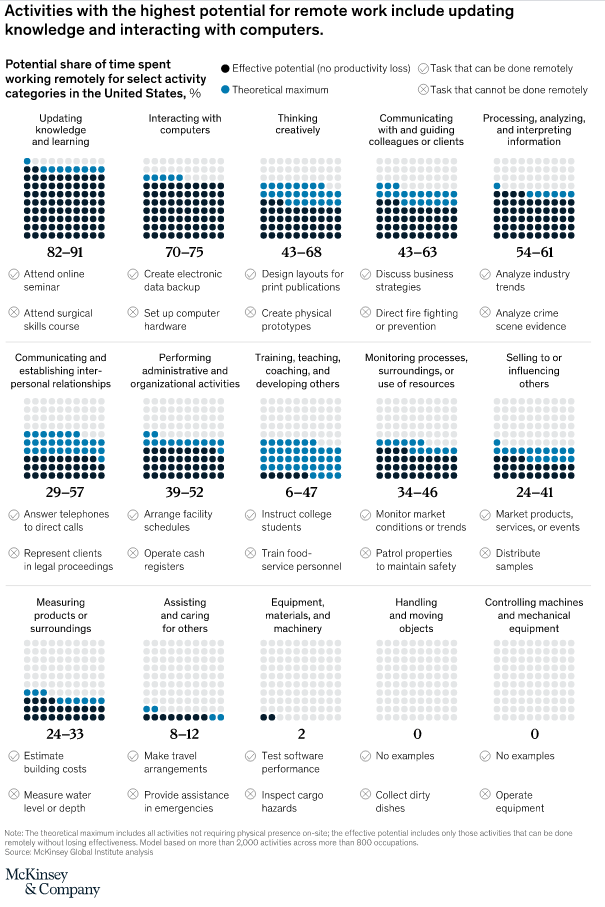
The researchers found that remote
work potential is concentrated in a few sectors. Finance and insurance have
the highest potential with three-quarters of time spent on activities that can
be done remotely without a loss of productivity. Next will be management,
business services, and information technology. These sectors are characterized
by a high share of workers with college degrees or higher.

The third diagram shows remote work
potential varies across countries. Advanced economies have higher potential
in remote work. For instance, in UK, business and financial services constitute
a large share of the country’s economy. The workforce could theoretically work
remotely one-third of the time without any loss of productivity.

A hybrid model that combines some
remote work with work in an office is possible for occupations with high remote
work potential. In the US workforce, McKinsey found that 22 percent of
employees could work remotely between three and five days a week without
affecting productivity, while only 5 percent could do so in India.

With nine months of experience working
remotely, more employers are seeing somewhat better productivity from their
remote workers. Some managements express confidence that remote work can
continue. Meanwhile, some others say they see few positives to remote work.
Employees too have gained experience
working remotely during the pandemic, and their own confidence in their
productivity has grown. The number of people saying they worked more
productively has increased by 45 percent.
Some forms of remote work are likely to
persist long after the pandemic. This will require many shifts, such as
investment in digital infrastructure, freeing up office space, and the
structural transformation of cities, food services, commercial real estate, and
retail. It also risks accentuating inequalities and creating new psychological
and emotional stresses among employees, including from isolation. However, by
removing the requirement to be in a physical office, businesses can provide
access to new talent pools like working mothers, veterans and people with
disabilities. No matter what, the new working normal may transform us into a
better society with more flexibility and higher productivity.
Reference:
What’s next for remote work: An analysis
of 2,000 tasks, 800 jobs, and nine countries, McKinsey Global Institute
(November 2020)

As the greenback continues to weaken,
Ringgit rose to 4.0472 on 16 Dec. 2020, its highest level since July 2018. This
breached the year’s previous high of 4.0515 against the US dollar in January.

The greenback is weak due to super-low
interest rates in the U.S., but economists and currency strategists also
attributed the Ringgit’s strength to the global economic recovery fuelled by
the development of Covid-19 vaccine and strong crude oil prices.
The Covid-19 vaccine rollout would allow
the reopening of the economy, which could stimulate global economic activities.
This, in turn, would increase the demand for fuel. The Opec+ member countries’
decision to reduce oil production by 0.5 million barrels per day (mbpd) from 7.7.
mbpd to 7.2 mbpd in 2021 should also support crude oil prices.
AxiCorp Financial Services Pte Ltd chief
global market strategist Stephen Innes told The Malaysian Reserve that the
Ringgit could appreciate to RM4 to the dollar, if Brent trades at US$60 per
barrel (currently trading at US$50.70 per barrel, 15/12/2020). For the Ringgit
to gain further, it may require domestic economic activity to rebound and a
drop on interparty political tension. If this does happen, according to Innes,
the Ringgit could rally to RM3.90 to the dollar soon. This is also predicated
that the US dollar will continue to weaken.
“With the vaccine rollout, the ringgit
also stands to gain from more exports heading west. Simultaneously, the
thriving Malaysian travel industry should receive a huge bump in tourist
activity once air travel lanes finally open up more freely,” he said.
Oanda Corp Asia-Pacific senior market
analyst Jeffrey Halley pointed that the resumption of interstate travel in
Malaysia will also boost domestic economic recovery, but its effectiveness
depends entirely on containing the spread of Covid-19.
Bank Islam Malaysia Bhd chief economist
Mohd Afzanizam Abdul Rashid told StarBiz that he anticipates that the overnight
policy rate to remain unchanged at 1.75% next year. From an interest rate
differential perspective, he said Malaysian assets would provide better yields
and attract investors looking for higher returns.
However, from the Nominal Effective
Exchange Rate (NEER), the ringgit may still hover below 100 points. In that
sense, the Ringgit is weaker against certain currencies, namely the euro, South
Korean won, Aussie dollar, Chinese yuan, Japanese yen and Singapore dollar. As
of 16/12/2020, Malaysia is still one of the countries in Southeast Asia with
the highest number of Covid cases recorded in the last 24 hours. The spike in
Covid-19 cases is posing uncertainties to the recovery of the country’s economy.

Covid-19 cases by country (16 Dec 2020)
Source: https://www.csis.org/
A strengthening of currency is not particularly
welcome by most exporters. Importers see it as a boon while imported inflation,
if any, is further dampened. Outbound tourists see it as a benefit for travel
in 2021. The real issue is whether we provide higher value through enhanced
productivity or are we relying on short term measures to resolve long term
problems.
Reference:
1.
Daljit
Dhesi, Room for ringgit to appreciate, 14 Dec 2020, The Star
2.
Nur
Hanani Azman, Ringgit set to gain on stronger oil prices, 14 Dec 2020, The
Malaysian Reserve
In October 2020, Hyundai started
construction of a RM 1.22 billion, 30,000 electric vehicle a year plant in
Jurong, Singapore. When completed in 2022, the Hyundai Mobility Global
Innovation Centre (HMGICs) will be the Hyundai Motor Group’s (which also
includes Kia) regional hub for electric vehicle (EVs) production and
development. Out of the 30,000 EVs to be built there, about 5,000 to 6,000
units will be sold in Singapore, while the rest will be exported (Hans, www.wapcar.my).
Why did Hyundai choose Singapore instead
of Malaysia when Singapore’s wage structure is high? Even more surprising is
that Hyundai Motor has a 15 percent stake in the Inokom assembly plant in Kulim
but chose to overlook Malaysia and picked Singapore and Indonesia.
Malaysia sold 2,256 units of Hyundai
cars in 2019, far below Singapore’s 5,618 units but more than Indonesia’s 1,365
units. Hence, the sales volume is unlikely to be a factor on Hyundai’s decision.
What attracted Hyundai is the push for
electric vehicles in Singapore and Indonesia. Singapore is phasing out
combustion engines by 2040 and has established test-bed zones for autonomous
vehicles. Singapore has also gazetted 1,000 km of roads to test autonomous
vehicles in real-world driving conditions.
In January 2018, the Hyundai Motor Group
invested in Singapore’s Grab and started rolling out EV variants of the Hyundai
Ioniq. By November, Hyundai invested RM1.04 billion into a South East Asia-wide
EV partnership with Grab. Grab has also launched its GrabCar Elektrik service
in Jakarta and will roll out 500 units of Hyundai Ioniq EV there.
Hyundai knows that it will be difficult
to get consumers to migrate to EVs in a big manner, and this is where Grab
comes in. Car sharing, e-hailing, even driverless taxis are logical, more
acceptable touch points to get consumers become familiar with EVs.
Indonesia holds 25 percent of the
world’s nickel reserves, a crucial element in the manufacture of high voltage
batteries for EVs. Their President, Widodo, wants to establish Indonesia as a
centre for EV batteries and vehicle manufacturing, targeting to see 2,200 units
of EVs, 711,000 units of hybrids, and 2.1 million units of electric motorcycles
in Indonesia by 2025.
Since January, Indonesia has banned
exports of nickel. This is despite protests from mining companies. The
Indonesian government is showing great resolve by putting its foot down in
prioritizing their country’s longer term good.
In future, cars are less likely to be
purchased and owned privately but will evolve into a shared or subscribed
service. Mobility as a service is the keyword here, which is why Hyundai isn’t
too bothered about its present low sales in Indonesia and Singapore. Their priorities
are forward thinking government policies and a rich pool of intellectual
technical talent.
Apart from Hyundai, Toyota, BMW, and
Mercedes-Benz too have completed their electric/plug-in hybrid vehicle battery
plants in Thailand. Where is Malaysia? As the only Asean nation with the
capability to fully design, engineer and manufacture cars from the ground up,
shouldn’t Malaysia be at the forefront of this EV charge in the region? The
National Automotive Policy was announced on 21 February 2020. It has a lot of
new policies and ambitions—next generation vehicles, mobility as a service and
Industrial Revolution 4.0. It is now close to a year. Lots of MoUs signed but
no actual development. Is that Malaysia?
References:
1.
Hans,
The Malaysian link behind Hyundai’s decision to build this sexy EV in
Singapore, www.wapcar.my/
2.
Daniel
Fernandez, Why isn’t Malaysia leading the charge in EV development? www.freemalaysiatoday.com/
Perhaps the easiest way to understand
why colonialism was horrific is to imagine it happening in your own country.
Visualise you are invaded, conquered, and occupied by a foreign power. Existing
governing institutions are dismantled and replaced by absolute rule of the
colonizers. A strict hierarchy separates the colonized and the colonizer; you
are treated as an inconvenient subhuman who can be abused at will. The
colonists commit crimes with impunity against your people. Efforts at
resistance are met with brutal reprisal, sometimes massacre. The more vividly
and accurately you manage to conjure what this scenario would actually look like,
the more horrified you maybe.

One may think this revulsion was now
universally shared. But that is far from being the case. The majority are still
proud of colonialism and the Empire. Americans continue to show an almost total
indifference to the lasting poverty and devastation inflicted on the indigenous
people in the U.S. Harvard historian Niall Ferguson has long defended the
British Empire as a force for good in the world. And, Princeton PhD and
Portland State University professor Bruce Gilley has published an unapologetic
“Case for Colonialism” (in Third World Quarterly) in a respected academic
journal (Nathan J. Robinson reviewed Bruce Gilley’s article on 14 Sep 2017, www.currentaffairs.org).
Gilley’s article takes a very clear
stance: not only was colonialism a force for good in the world, but
anti-colonial sentiment is “preposterous.” What’s more, Gilley says, we need a
new program of colonization, with Western powers taking over the governing
functions of less developed countries. Gilley’s article is a truly
extraordinary piece of work.
Gilley’s argument is, roughly:
opposition to colonialism is reflexive rather than reasoned. This has caused
terrible consequences, because postcolonial governments have hurt their people
by attempting to destroy beneficial colonial institutions. The “civilizing
mission” of colonialism was valuable and had a positive effect. Colonialism was
legitimate because it helped people and many were willing to tolerate it. Anti-colonial
arguments are often incoherent, blaming colonial governments for all ills
rather than examining what would have occurred in the absence of those
governments. And colonialism should cease to be a dirty word; in fact, it
should be re-instituted, because many developing countries are incapable of
self-government.
If you are unfamiliar with history,
Gilley’s argument could appear superficially persuasive. But a moment’s
examination of the record reveals why the case he makes is abhorrent. Gilley says
he is simply asking for an unbiased assessment of the facts, that he just wants
us to take off our ideological blinders and examine colonialism from an
empirical perspective. But this is not what he has done. Instead, in his
presentation of colonialism’s record, Gilley has deliberately excluded mention
of every single atrocity committed by a colonial power. Instead of evaluating
the colonial record empirically, he has distorted that record, concealing
evidence of gross crimes against humanity. It is morally tantamount to
Holocaust denial.
First, Gilley says he is making a “case
for colonialism,” to rescue Western colonial history’s “bad name.” But he
restricts his examination to “the early nineteenth to mid-twentieth centuries.”
He does so because if he were to include the first 300 years of Western
colonialism (i.e. the majority), it would be almost impossible to mount any
kind of case that the endeavour benefited indigenous populations. The
civilizations of the Americas were exterminated by colonialism. Disease,
displacement, resource depletion, one-sided warfare, and outright massacre, and
their populations suffered a “catastrophic collapse.”
Next, Gilley’s method of defending
colonialism is through “cost-benefit analysis,” in which the harms of colonialism
are weighed against the “improvements in living conditions” and better
governance. Where colonial rule had, on balance, a positive effect on training
for self-government, material well-being, labour allocation choices, individual
upward mobility, cross-cultural communication, and human dignity, compared to
the situation that would likely have obtained absent of European rule, then the
case for colonialism is strong. Conversely, in times and places where the
effects of foreign rule in these respects were, on balance, negative compared
to a territory’s likely alternative past, then colonialism is morally
indefensible according to Gilley.
This is a poor way of evaluating
colonialism. It is favoured by colonialism’s apologists because it means that
truly unspeakable harms can simply be “outweighed” and thereby trivialized.
Gilley and other colonial apologists are like the husband telling his wife that
while she may not like being hit, she should remember who provides for her. To
exonerate colonial powers by suggesting that enough economic growth could
somehow make a “strong case for colonialism” even if there had been constant
mass rape and torture is unconscionable.
But even if we assume that
“cost-benefit” analysis is the correct way to examine colonialism, Gilley has
to distort the evidence in order to prove his case. For example, he says “since
gaining independence, Congo has never had at its disposal an army comparable in
efficiency and discipline” to that it had under the Belgians. “Maybe the
Belgians should come back.” If one knows anything about the history of the
Belgian Congo, one knows that this statement is equivalent to saying “Maybe the
Nazis should come back”. Belgian King Leopold created possibly the most
infamous colonial regime in history. Contemporaries called it “legalized
robbery enforced by violence,” and Leopold “turned his ‘Congo Free State’ into
a massive labour camp, made a fortune for himself from the harvest of its wild
rubber, and contributed in a large way to the death of perhaps 10 million
innocent people.” Belgian rule in the Congo was a reign of terror that
scandalized the world.
What happened in India under British
rule: the horrific Amritsar massacre, the mass famines that killed millions,
and the horrors of the partition are real costs. French crimes in Algeria,
Indo-China, and other places; German genocide in Namibia are other examples.
One of the cruellest aspects of colonialism is the way it forces the colonized
into servility and obedience. This is a “cost” and not a benefit.
What does it take to restore warm,
cordial relations between former colonials and the ones who were colonized?
On 1 September 2019, the 80th
anniversary of the start of the Second World War, the German President
apologised to his Polish counterpart for the Nazi invasion of Poland. Earlier
in the year, on the 100th anniversary of the Amritsar Massacre, Theresa May
expressed ‘regret’ for what had happened, but stopped short of an outright
apology.
“A simple sorry would do” (as Shashi
Tharoor puts it).
But beyond being ‘sorry’, genuine
remorse could lead to:
i.
‘A
Day of Atonement’, one day in the year when everyone colonised and the
colonisers remember the atrocities perpetrated. It is like a Memorial Day for
WW1 or WW2;
ii.
An
unvarnished account of the ‘Colonial Era’ taught in schools of both the
colonisers and those former colonies;
iii.
An
education/ scholarship fund which is enough to educate 100,000 students
annually from former colonies;
iv.
A
health assistance programme to bring modern facilities into former colonies;
v.
A
poverty eradication scheme to help people in former colonies have self-sustainable
lives.
There could be many more ideas to bridge
peoples if there is genuine feeling of compassion and love. And that truly is
Christmas!
Reference:
1.
Nathan
J. Robinson, A Quick Reminder Of Why Colonialism Was Bad, 14 Sep 2020 www.currentaffairs.org
2.
Shashi
Tharoor, Inglorious Empire: What the British did to India
Airbnb’s share (ABNB) was priced at $68 a share on the NESDAQ but the company started trading at over $150 a share on the first day of listing (10 Dec 2020) and closed the day at $144.70.
Founded in 2008 after co-founders Joe
Gebbia, Brian Chesky and Nathan Blecharczyk came up with the idea of renting
air mattresses in their San Francisco apartments. Airbnb now has more than 7m
short-term listings worldwide. And at $100bn, it is valued at twice the value
of Marriott, the largest hotel operator.

What makes ABNB so valuable?
The Marketplace: As of Sept. 30, 2020, the company
reported 7.4 million available listings, 5.6 million of which are considered
active listings. That scale is more of an advantage than one might realize.
Airbnb's marketplace has strong network effects, in that the more people who
use it, the more powerful and useful its platform becomes. It's a trait shared
by several leading online operators, including Facebook (FB), Alibaba (BABA)
and eBay (EBAY).
Organic reach: The company says that during the first
nine months of 2020, 91% of all traffic to Airbnb came through direct or unpaid
channels.
Economic improvement: Any advances against COVID-19 –
specifically, potential vaccines from the likes of Pfizer (PFE) and BioNTech
(BNTX), Moderna (MRNA) and others – are expected to be a boon for the entire
travel industry, Airbnb included.
Market opportunity: Airbnb estimates the size of its total
addressable market is a staggering $3.4 trillion. This includes $1.8 trillion
for short-term stays, $1.4 trillion for travel experiences, and $210 billion
for long-term stays and $1.4 trillion for travel experiences. There's plenty of
room for multiple operators.
The "Google" effect: Airbnb is beginning to become Google-fied.
The word "Airbnb" is becoming at the top-of-mind, the way people
describe this new form of vacationing. This, even when one is not actually
using Airbnb itself.
The experience: Airbnb's service allows for more
compelling experiences than the ordinary hotel room. It's described well in the
S-1: "Instead of traveling like tourists and feeling like outsiders,
guests on Airbnb can stay in neighbourhoods where people live, have authentic
experiences, live like locals, and spend time with locals in approximately
100,000 cities around the world."
Meanwhile, ABNB faces several risks
which investors should consider too:
Legal uncertainty: While renting out one's home has been
normalized thanks in large part to Airbnb, it's still not a settled area from a
legal standpoint. And the powerful hotel industry lobby has been aggressively
working to get municipalities to enact strict regulations against these sorts
of home-renting services.
Risks to hosts and guests (part 1): Hosts and guests alike take on numerous
risks in these home-renting transactions. Airbnb admits that "there have
been shootings, fatalities, and other criminal or violent acts on properties
booked on our platform," as well as "sexual violence against hosts,
guests, and third parties," and "undisclosed hidden cameras at
properties." A growth in such issues could deter hosts from continuing to
engage with the platform.
Risks to hosts and guests (part 2): In many cases, hosts have made claims
seeking compensation for several violations committed against them and their
homes. "These claims subject us to potentially significant liability and
increase our operating costs and could materially adversely affect our
business," the company writes.
Competition: Airbnb must contend with online
platforms such as Booking Holdings (BKNG), Expedia (EXPE) and Trip.com. It even
faces competition from search engines and meta-search sites, including Google,
Baidu (BIDU), TripAdvisor (TRIP) and Trivago (TRVG) that control huge web
traffic. There are also competitors like Airbnb, such as Vrbo and Expedia's
HomeAway. And of course, there's an entire hotel industry to deal with.
The analysis of ABNB above is largely reposted
from Yahoo Finance. Remember, whether you decide to buy ABNB shares ultimately
comes down to your own risk appetite and investing horizon. MPCA accepts no
responsibility or assumes any liability for your decision to invest or
otherwise.
Reference:
1.
Airbnb
soars to near $100bn valuation as shares more than double in IPO, 10 Dec 2020,
The Guardian
2.
The
Airbnb IPO: Should You Buy ABNB? 10 Dec 2020, Yahoo Finance
In
Malaysia, there are at least two million migrant workers mostly from Indonesia
and Bangladesh, making up 15% of the total employed persons. Since Malaysia
went into lockdown in March 2020, the Malaysian Trades Union Congress (MTUC)
has reported cases of violation of migrant workers’ rights by their
employers, including unfair termination, unpaid wages, poor living conditions
and more (Top Glove is a good example). Those who were laid off would have lost
their work passes, forcing them to become undocumented. Since May 2020, the
Malaysian government has conducted several immigration raids, detaining more than 18,000 undocumented
migrant workers. Many
became infected as the over-crowded detention centres
became coronavirus hotspots. These
cases are just the tip of the iceberg—without any official account, the fate of
other undocumented migrant workers remains largely unknown.
The
Malaysian government has arguably provided only limited assistance to the
migrant population. So far, one of the most prominent government initiatives
related to the workers is the 25% cut for the migrant worker levy for the rest
of the year.
However,
even from a purely economic perspective, the “citizens’ welfare-comes-first”
ideology must give way to an inclusive protection measure. Although some may
argue that given limited resources, governments have an obligation to
prioritise its citizens over migrants, there are several strong economic
arguments against the marginalisation of migrant workers.
Malaysia’s
economy has long been reliant on the migrant workforce. In 2019, migrant
workers made up more than 30% of the workforce in the agriculture sector, and
more than 20% in both the construction and manufacturing sectors (Figure 1).
Almost half of the low-skilled workers in Malaysia were of foreign origins. For
semi-skilled jobs, where the bulk of jobs are, more than one in 10 were migrant
workers. Overall, it has been estimated that 22% of the establishments in Malaysia
hired migrant workers.

Figure 1: Migrant workers are important to Malaysia’s economy
 Figure 2: The
importance of migrant workers in the manufacturing and services sector
Figure 2: The
importance of migrant workers in the manufacturing and services sectorIn July
2020, the Malaysian government announced that migrant workers are limited to working
only in the agriculture, plantation and construction sectors, as part of its
strategy to keep Malaysians employed.
Despite
their relatively low share of migrant workers, the manufacturing and services
sectors actually hired the largest number of migrant workforce, totalling
almost 1.5 million persons (Figure 2). The number of migrant workers employed
in both sectors is the fastest-growing ever since 2010. Furthermore, the
manufacturing sector also recorded one of the highest percentages of
establishments (63%) that employed migrant workers in 2018.
The idea
that without migrant workers, firms can easily hire locals to replace them
misses an important point—migrant and local workers are generally imperfect
substitutes. Between 2010 and 2019, most of the migrant workers who entered the
labour market had at most a secondary education (Figure 3). By contrast, the
Malaysian labour force is getting more educated—there have been fewer people
with only primary education or less, and nearly two million more who are
tertiary-educated. This partly explains why within the same decade, most
migrant workers tended to go into low-skilled jobs, whereas Malaysians were
mostly hired in skilled and semi-skilled occupations.

Figure 3: Migrant and local workers occupy different occupational space
Lower-educated,
low-skilled migrant workers often take on jobs that are deemed dirty, dangerous
and difficult (3D), which are also jobs that Malaysians usually shun. Indeed,
based on a survey conducted by the Malaysian Employers
Federation (MEF) involving 101 member companies, around 78% of the companies
reported that the main reason for them to recruit migrant workers was the
“shortage of local workers to fill vacancies”.
Hence, in
requiring employers to hire only local workers post-lockdown, the government
may be putting employers in a very challenging position. For example, following
the government’s directive to stop hiring migrant workers, market traders at
the wholesale and wet markets have found it hard to hire. The jobs that migrant workers do are often too
demanding for the locals, that it now takes two locals to handle one migrant
worker’s workload. As such, the market has been functioning at less than 20% of
its full capacity due to the manpower disruption.
It
is also observed that industries with low productivity have a high share of
low-skilled foreign workers (Figure 4), with a greater reliance on longer
working hours to produce output. One study found that South Korea increased
real GDP per hour from USD4.7 in 1980 to USD25.4 in 2010, while Malaysia only
registered an increase to USD7.1 in 2010 from USD5.3 in 2000. South Korea did
this while reducing average weekly working hours from 49 hours to 44 hours from
2000 to 2008, while Malaysia held steady
at 49 hours. Malaysia’s labour-intensive methods and longer working hours are
clearly less efficient than those obtained through technological advancement
and automation. This is seen through the gap between Malaysia and Asia’s
average usage of industrial manufacturing robots (Figure 5).

Figure 4: Productivity and Share of Foreigners by Industries

Figure 5: Robot Density in the Manufacturing Sector (2016)
From the
workers’ perspectives, automation and new technology are bound to replace jobs,
and it is Malaysians who are at the highest risk of job displacement, not
migrant workers. Based on the findings by KRI, in the next two decades,
54% of all jobs in Malaysia could be displaced by technology. Four out of five
of these high-risk jobs are semi-skilled jobs. Malaysians will be most affected
because 86% of all semi-skilled jobs are held by Malaysians. The hollowing out
of semi-skilled jobs by technology has already been evident since 2000 (Figure 6).
The void is only expected to deepen further with the rapid progress in
technology.

Figure 6: The disappearing middle
The road
to economic transformation comes with its own set of labour and industrial
challenges. Reducing Malaysia’s reliance on migrant workers could be an
important policy lever to drive transformation. That pre-supposes sound labour,
industrial and education policies that will see a sustainable creation of
quality jobs, and prepare all Malaysians for the rapidly evolving employment
landscape.
What can
we do in the immediate term? We need to improve our thoughts (and deeds) on
migrant workers. They are here as our guests. We cannot and will not do their
jobs. There is need for compassion and basic improvements to work and living
conditions. Next, we need to reduce the levy or create a graduated scale for
different sectors. In addition, we need to review our automation/robotics
strategy. If South Korea can do it, why can’t we?
For
Malaysians, it is good if the Government planners work closely with industry
and tertiary institutions. Otherwise, we may have surpluses in humanities,
Islamic knowledge and/or medicine. It is disheartening for parents when their
children graduate but cannot find a suitable job. Then we want more people to
do STEM when the prospects seem so limited. Learn from Singapore, how to do
R&D clusters or other similar strategies to encourage start-ups and
innovation.
Don’t
think too long! Don’t need a Vision 2030! Just look at Vision 2020, and what a
disaster that has become – and as usual, no review or audit of that failure.
Going
forward, Just do it! (if not buy a Nike?).
References:
1. The economic case against the marginalisation of migrant workers in
Malaysia, Tan Theng Theng, Jarud Romadan, October 1st, 2020 (https://blogs.lse.ac.uk)
2.Low-skilled foreign workers distortions to the economy, Ang Jian
Wei, Athreya Murugasu, Chan Yi Wei, Economics Department, Bank Negara Malaysia,
March 2018
3. Migrant workers: A forgotten economic muscle, G Vinod, Focus
Malaysia, 01/12/2020
