Tuesday, 4 October 2022

Are Singaporeans Tourists Not Welcome in Malaysia?

Tourism Malaysia has released the figures for foreign visitor arrivals for the first half of 2022. The total number of foreigners that entered our country from January to June was 3,016,113, comprising 2,132,160 tourists and 883,953 excursionists.

During the same period last year, the total number of foreign visitors was 188,922, consisting of just 50,613 tourists and 138,309 excursionists. In contrast, there were 5,965,137 foreign visitors to Malaysia in the first half of 2020, with 4,252,997 being tourists and 1,712,140 excursionists.


Source: https://en.wikipedia.org


It would take several years for foreign visitor arrivals to return to 2019 levels. As many as 18,137,162 entered Malaysia in the first half of that year, with 13,354,575 tourists spending an average of 7.4 nights and 4,782,587 excursionists departing on the same day of arrival.

For the first half of this year, 60% of all foreign tourists and 75% of all excursionists were Singaporeans. In the four years from 2012 to 2015, more than half of all foreign tourists to Malaysia were Singaporeans, averaging 12.9 million per year. But after that, the percentage dropped to 49.6% in 2016, 47.9% in 2017, 41.1% in 2018 and 38.9% in 2019, averaging 11.6 million per year.

One of the main reasons was congestion at entry points by road that affected not only excursionists but also tourists. Bear in mind that expenditures by Singaporean tourists travelling all over peninsular Malaysia, Sabah and Sarawak were among the top three on per diem basis, just below nationalities from Saudi Arabia and Brunei, and above those from Australia and China. Together, the 5,381,566 Singaporean tourists contributed RM11.56 billion to our economy in the first half of 2019.

Shouldn’t we make Singaporean tourists feel more welcome? This is especially true for our immigration officers, as they exert a huge impact on the first impression of our country. There are immigration officers on duty who habitually make sarcastic remarks on frequent entry by Singaporeans into Malaysia. Instead of welcoming them, they are bothered by foreigners entering Malaysia.

Over 25% of foreign tourists cited visiting friends and relatives as the main purpose for visiting Malaysia in the first half of 2019. But unlike 71% of domestic tourists that stayed at free accommodation provided by friends and relatives, foreign tourists prefer to stay in licensed hotels or private residences booked online.

To surpass the target of 10 million foreign tourists by the end of this year would require an average of 1.33 million arrivals per month or eight million over six months, as 2,132,160 tourists came in the first half of this year.

Under the National Tourism Policy 2020-2030, there are 22 strategic action plans in place with four on governance capacity. They are for strengthening high-level coordination to monitor the implementation of the policy; enhancing tourism core skills of related government agencies; increasing the capacity and tourism knowhow of local authorities; and embracing innovative governance models to facilitate participatory processes and public-private sector partnerships.

To be more competitive, the Tourism Ministry should reinvigorate the Mesra Malaysia programme. It is the most effective training for public and private sector front liners to become warm and friendly hosts. We have a serious deficiency in manners especially to our neighbours. Next, we could improve entry point experience with reduced waiting times, especially amplified in a holiday season. That may require some initiative and a few ringgits to increase spending (in Malaysia). Why can’t we do that?


Reference:
Make Singaporean Tourists feel more welcome, YS Chan, Letter to the Editor, FMT, 14 September 2022

Monday, 3 October 2022

What If PAS Rules?

The survival of an inclusive multi-racial Malaysia could be under threat if PAS were to rule. The Islamist party is confident that its time has arrived to take charge of the country’s destiny. To climb this peak, PAS will have to capture more political power in every general election, and it probably reckons it can only achieve this by getting more Malay votes. In PAS’ calculations, the other ethnic groups do not count.

PAS election director Sanusi Md Nor has got the party’s long march to Putrajaya all mapped out. This controversial Kedah menteri besar expects PAS to “attack” 80 parliamentary seats and is confident of capturing at least 40 in GE15. The party now has 17 MPs, of which three are ministers and eight deputy ministers. 


Source:https://www.bharian.com.my


PAS has already mapped out a 30-year plan to capture federal power. It foresees that by 2050, it will have enough MPs to form the next government, with its candidate as the prime minister.

The coming general election (GE15) will be a crucial test on whether PAS can make further inroads. If the party led by Hadi Awang can seize 40 seats, it would have a big say in the corridors of power. Hadi can drive his Islamic agenda to the forefront of national politics to reshape the landscape of this multi-racial nation. If PAS can continue to improve its electoral outings over the next 30 years, it will inch its way to a simple majority eventually and later, an overwhelming victory.

But PAS alone without UMNO or PN will fare badly. That’s the perception of a UKM political analyst. It (PAS) was in the PH camp for GE14.
The above scenario could only happen if the other Malay parties like UMNO and Berstu fall by the wayside. And the multi-racial parties like PKR, DAP and Amanah are unable to muster Malay votes.

PAS won’t find it easy to secure Malay support, let alone the non-Malay votes. Perhaps, the good news is PAS is performing poorly in the states it governs, its leaders have no clear direction and ministers are incompetent. But if a leader with the calibre of Tok Guru emerges, then the proposition may look possible. Otherwise, this will remain a pipe-dream! We cannot be complacent to this possibility. The consequences of which are seen in Pakistan, Afghanistan, Libya or other Islamic republics –all failed economies.


References:
If PAS rules, the lights of freedom will grow dim, Philip Rodrigues, Aliran, 7 Sept 2022

PAS growing unpopular even among Muslims, says analyst, Shahrul Shahabudin, FMT, 
12 September 2022

Friday, 30 September 2022

Can We Have Malaysia Savings Bonds?

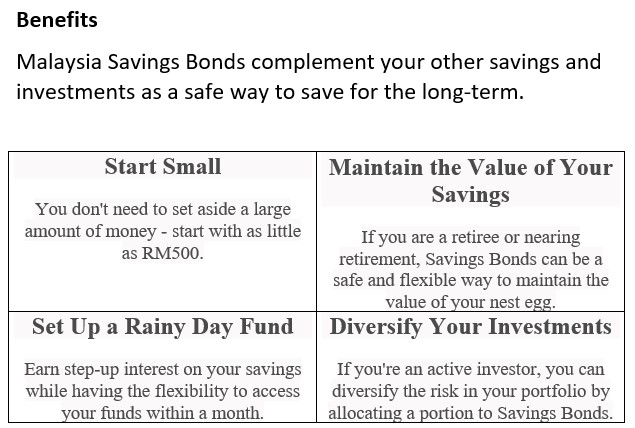
 An illustration of the proposed Malaysia Savings Bond includes:


The above illustration is based on the Singapore Government’s Savings Bonds for retail investors. Why can’t we have this to fund Government development projects? Is MOF/BNM able to organise it?

Savers are currently paid pittance even in a rising interest environment. The current savings rate is about 0.2% p.a, well below inflation. Couldn’t the banks/MOF assist savers to get a fair return?


Reference:

Monetary Authority of Singapore


Thursday, 29 September 2022

Can You Work Till You Die?

Nearly two centuries ago, lexicographer Noah Webster defined “retire” and “retirement” as a form of withdrawal: retiring for the evening, for example, or retiring from public life. But retiring to pursue hobbies and spend more time with the grandchildren while living off a lifetime’s worth of savings invested in stocks and bonds? No.

Back when Webster was doing his defining, 70% of white men over the age of 65 worked for a living. Official rates for women were lower.


Source: https://www.theatlantic.com


The toil-until-you-die mentality was arguably a necessity, particularly on family farms where most Americans lived and worked at the time. Historians have also argued that it reflected respect for the elderly, who accumulated useful knowledge about farming over the course of their lives. The small-scale industrial enterprises that were just beginning to transform the U.S. economy also employed the old, but for different reasons. These firms often depended on family and community connections to recruit and retain workers. Owners and managers realised that putting older relatives to work would help them hire younger labourers as well.

Factories grew larger, but managers kept graying workers on the payroll. Some did so out of compassion, but others believed that older employees were more conservative and consequently less likely to succumb to radicalism and strikes. They could also be employed as reserves during times of labour unrest.

Beginning in the 1890s, though, men over 65 began to “retire” from the workforce. This shift arguably began when late-19th century unions and progressives pushed to reduce the length of the working day, which often lasted between 10 and 12 hours. They demanded an eight-hour day, and eventually, a five-day work week.

As reformers made inroads, companies became increasingly sensitive to productivity issues: They now needed to produce the same amount as before, but with far fewer hours. Inefficiencies that might have been acceptable in the past now became intolerable. This spelled trouble for older workers. 

As Americans internalised the idea of retiring, they lost touch with its problematic origins. This amnesia made it difficult to imagine alternatives to retirement that did not involve a full-scale separation from the workplace, such as part-time work or other flexible arrangements.

And now that leaves the United States in an increasingly untenable position as it confronts a persistent labour shortage. The workforce participation rate for people over the age of 65 is stuck at 23%. In fact, many of the unfilled positions are in professions that are likely to continue seeing high demand even in a recession – teachers, for example.

There is a solution. Greater acceptance of flexible or “phased” retirement would enable older workers to retain an income while still spending more time on leisure. This approach can help alleviate shortages of workers, and it may also lessen the burden on the social safety net by keeping seniors engaged and active.

Companies and public agencies should put more effort into extending such part-time opportunities to their older workers instead of thinking of retirement as being either an all-or-nothing stage of life.

In Malaysia, we have older folks with low-savings. It is difficult to retire unless you have savings of at least RM250,000 in present day terms. This is a bare minimum, and many don’t even have more than RM10,000 in their EPF at 60. So, flexible arrangements are the way forward. Perhaps working in a part-time arrangement to 75 will help. If one keeps well, i.e. mentally and physically fit, it is possible. It also reduces the possibility of early onset of dementia or stroke. Perhaps, insurance companies, medical institutions and the Government could work towards a scheme for senior part-timers who are willing and able to work to 75!

Reference:
Ready to work until you die? America needs you, Stephen Mihm, The Star, 10 Sept 2022

Wednesday, 28 September 2022

Is Malaysia Unlikely To Go Into Recession?

 In August, Finance Minister Tengku Zafrul Aziz said Malaysia’s economic outlook could be hurt by pessimism in the global economy. Bloomberg quoted him as saying Malaysia must be prepared for a slowdown in the global economy, despite the country’s strong economic expansion following the reopening of its borders and booming exports. But Bursa Malaysia’s Chairman thinks otherwise.

Pragmatic and responsive policies as well as an economy which is well-diversified are factors that could prevent Malaysia from going into recession. In addition, Bursa’s Chairman cited that one important factor that has contributed to Malaysia’s resilience is its strong and stable financial system. Debt and Equity markets are valued at RM3.5 trillion as of the end of 2021.


Source: https://www.thesundaily.my


The former economic affairs minister, however, noted that global supply chains had been under pressure with economies returning to normal post-pandemic, exacerbated by trade tensions between US and China as well as the Ukraine-Russia conflict. These factors had caused commodity and logistic prices to surge, in turn causing high inflationary pressure which forced central banks around the world to tighten their respective monetary policies.

There are at least two problems with this thinking:

(i) Financial system only lubricates the economy or provides the “blood flow” in a body – it does not generate GDP per se. If you have done Economics 101 you may understand that growth is the summation of consumption, investment, government intervention and net foreign trade/services. Banks being well capitalised and resilient means it could weather a downturn, not generate growth. In a recession (or potential downturn) outlook is dimmed, businesses invest less and generally Government expenditure may stem negative growth.

(ii) Central banks tighten interest rates to deflate inflationary pressures not because of logistics or supply chain disruptions. The latter is a cost-push phenomenon, not a monetary one. Printing money during Covid has now come to roost. Hence the interest rate hikes.
Malaysia’s resilience is due to its diversified export commodities and the manufacturing sector – primarily E&E. But we need to improve output disruptions due to labour shortages in the manufacturing, plantations and construction sectors. That hampers growth. 

So, if we “buck the trend” it is pure Providence and not policies of a bereft Government!

Reference:
Malaysia unlikely to go into recession, says Bursa chairman, FMT Business, 14 September 2022

Tuesday, 27 September 2022

Is Malaysia in the Hunt for Talent?

The government’s recent decision to roll out a premium visa programme (PVIP) is aimed at attracting the rich into the country with the hope that they will spend and invest here.

The idea is not new. Portugal, for example, launched its “golden visa” programme some 10 years ago, and currently rates as one of the more successful destinations for such a programme. It has garnered around 27,000 successful applications since launching the programme. Other countries like Thailand and Singapore are also in the game.

Malaysia needs talent. There is a severe shortage of skilled labour in Malaysia today. Penang, the hub of the country’s semiconductor sector, suffers from a severe shortage of engineers. The Small and Medium Enterprises Association (Samenta) says that the northern state is short of 50,000 engineers and technicians.

Over the last eight months, persistent skilled worker shortage may have caused the manufacturing sector to lose out about RM50bil worth of business opportunities. That’s according to the president of FMM.


A quick look at the comparison between Malaysia’s PVIP and programmes by Singapore and Portugal (see table) shows two key points. One is that while Malaysia’s programme only offers residence visas, the other two countries offer PR and even citizenship.

Secondly, the participation fees for PVIP is way higher compared with the fees for Singapore’s Global Investor Programme or GIP or even Portugal’s Golden Visa Programme or GVP as shown in the table.

Under Singapore’s skilled labour pass, also known as S Pass, designed specifically for working mid-level skilled workers with a minimum salary of S$2,200 (RM7,056), Singapore offers permanent residence (PR) status after four years of job stability.

The idea of obtaining a PR status is definitely a key factor for skilled workers as to why they opt for Singapore. In Singapore, though, there are controls put in place to ensure that not too many foreigners are employed. For example, the number of S Pass holders in service industry businesses is limited to 15% of the total staff. In other industries, the limit stands at 20%. Interestingly, employers in Singapore are also required to purchase medical insurance for S Pass holders.

Part of the problem of the shortage of skilled manpower in Malaysia lies with the shortcomings in the education system. The FMM acknowledges the need for greater student participation in the fields of science, technology, engineering and mathematics or STEM. Current enrolment is only 40% from STEM, causing the supply of skilled labour to be insufficient for the country. The need for more graduates from STEM extends to almost all sectors in support of automation activities.

The quantum of skilled workers also plays an important role in the country achieving its ambition to be a developed nation, i.e. 45% of the workforce to be skilled by 2030. But are we serious? Because we keep attracting the low-skilled, low-pay labour force. And several ministries are involved in this recruitment with lucrative “arrangements”. So, in one sense we have lost even before we have begun!

Reference:

The hunt for talent, Kirennesh Nair, The Star, 10 Sept 2022


Monday, 26 September 2022

“Can I Advise You Something?”

We may have advisers in our companies/organisations, in our homes (usually your wife), in our schools or in other areas of endeavours. In all instances, advisers are there as resource people, proferring their thoughts when it is sought, not when it is not needed.

The High Court ruled that the ex-FLOM dominated her husband and had control over the former prime minister. In his 116-page judgment, the Judge said it was clear from the audio recording that the accused gave instructions to the ex-PM on government affairs. The judge was referring to the audio clip of “Can I advise you something” that went viral.

The judge said the accused’s tone was commanding and contrary to her contention that she heeded former PM’s prohibition on not meddling in government affairs.

He further added that an aide (Rosmah’s) was telling the truth when he said that the accused has an overbearing nature and the ability to influence decisions in the civil service as he has worked with her for many years and would have been able to witness this personally.

The judge further said Rosmah’s defence that she had never interfered in any Government’s project, was hearsay as Najib did not testify in court. He said the accused emphatically denied interfering in any of the government’s projects, especially in a RM1.25 billion hybrid solar project for 369 rural schools in Sarawak


Source: https://www.eqmagpro.com


All her statements attributed to Najib were hearsay and are inadmissible as evidence, as he did not testify and only he could verify what the accused claimed he had said.

The judge further said that the accused claimed that former Minister of Education and former secretary-general of Ministry of Education had a vested interest in the project and that they had cast aspersions on the accused to camouflage their wrongdoings on the project. The judge found no credible evidence to prove that both individuals had attempted to profit from the project.

There is a subtle difference between advice and advise. Advice is a noun. It means an opinion or recommendation that is offered as a course of action. Advise is a verb. It means to offer an opinion or suggestion or formally provide information. In ex-FLOM’s case, it is correct to use “advise” – she is giving direction to the former PM who follows that instruction.

There is nothing inherently wrong for a wife to advise her husband! But here it is on state matters, which impacts on integrity, policies and procedures. Rural school children in Sarawak are impacted by one person’s greed. So, what can we learn?

Greed is in all of us, but this was well above any decency;
“Checks and balances” obviously failed;
Civil service and Cabinet can be “stream-rolled”;
Non-party and non-Government individual can override Government decisions; and
Executive branch has far too much clout over our legislative branch. We are grateful the judiciary stood firm.

The present PM needs to reform the current practices and procedures to reduce another episode of “Can I advise you something?”

Reference:
Can I advise you something” shows Rosmah controls Najib, govt affairs: Court, Bernama