Monday, 13 February 2023

Did the Education Minister Fail?

What happened at a secondary school in Johor Bahru should not have happened at all in the first place. This is especially in the context of Malaysia Madani. The impassioned pledges made by Prime Minister in all his campaign speeches in the last general election, declared that all children whether they be Malay, Chinese, Indian, Kadazan or Iban, are his children.

To organise a special workshop for only Muslim SPM students is unbecoming. This is messing around with lives and minds of young Malaysians. To make it worse, the Ministry tried to apologise by coming up with a ridiculous explanation. It had to be for Muslim students first as it was during the Chinese New Year holidays. So why leave out the Indian students then? They were not celebrating the festival. Why can’t we admit our mistake and apologise? Problem is too many are brainwashed by the race and religion mantra.


Source: https://www.malaysianow.com


The session included core subjects like Science and Maths and was not just limited to Islamic studies. In any case, the SPM exams were to start soon, so there was no time for another session for the others. The parents also said their children have not been notified till now of any session for their children.

The Education Minister failed in her first major test. She cannot leave it to the education department to investigate. Education is a federal matter, more so if racism has been found to have crept into the system.
The power to summon the principal and the state education director immediately to explain was required by the Minister. She would have won the hearts of Malaysians if she had decided to go down personally to Johor. 

The anger was not only felt by non-Malays but others too, including the Johor Sultan, who wanted the issue resolved. So, what can the government do to ensure this does not happen again? Simple, actually. Take control and issue a blanket order barring any form of academic workshops based on race and religion, unless done specifically for the subjects of Islamic Studies, Chinese or Tamil. The government should show that there will be no mercy for people in authority who discriminate against people under their charge based on race or religion. Transfer, suspend or sack those who play on the race or religion card.

Many are saying this racist episode is unlikely to be the last, but the PM and his team must put these deviations to bed for a better Malaysia. So, did she fail? Yes, she doesn’t understand reformasi. And she is not alone.

Reference:
Education Minister fails in first major test, K. Parkaran, FMT, 28 Jan 2023


Friday, 10 February 2023

Is There Hope for MAS/MAG?

Loss-making Malaysia Aviation Group Bhd (MAG) — the parent company of national carrier Malaysia Airlines Bhd, FlyFirefly Sdn Bhd and MASwings Sdn Bhd — is sticking to its break-even target in 2023. This is despite managing to deliver a profit in the fourth quarter of 2022. Breaking even will mark a significant milestone in the aviation group’s Long Term Business Plan 2.0.

Its group CEO Captain Izham Ismail believes an inflection point is just around the corner. Two years after MAG successfully emerged from a restructuring involving RM15 billion of debt owed to 75 creditors, the group is expected to report higher revenue and a narrower net loss in the recently ended FY2022. This is largely due to resurgence in air travel resulting from the reopening of borders.

Source: https://www.wikidata.org


Based on preliminary unaudited results for FY2022, MAG posted earnings before interest, taxes, depreciation and amortisation (Ebitda) of more than RM1 billion, a 116% increase over the previous year. The group turned Ebitda positive of RM433 million in FY2021, from a loss or negative Ebitda of RM1.76 billion in FY2020.

The group expects revenue for FY2022 to triple to more than RM10 billion from RM3.96 billion in FY2021 as it adds more capacity and extends coverage. It is also poised to report an unaudited net profit of about RM600 million for 4QFY2022. This would be its first profitable quarter since it underwent a full reset in 2015. Sovereign wealth fund Khazanah Nasional Bhd took Malaysia Airlines private in 2014.

MAG’s operations have remained cash-flow positive in the past 450 days. The group has not draw down the remaining RM2.3 billion of new capital committed by its shareholder Khazanah. In February 2021, the sovereign wealth fund committed to inject a total of RM3.6 billion into MAG to fund the latter’s business until 2025 as part of the debt restructuring deal.


As fuel and other goods get more expensive, analysts have grown more concerned that more consumers could put off discretionary spending, such as travel. In view of this, 2023 offers no respite for the airline industry.

However, the higher airfares and additional revenue from increased capacity weren’t enough to offset headwinds. The group’s profit and loss statement remained in negative territory in 2022. It posted a net loss of RM1.65 billion for FY2021, a significant improvement from the previous year’s net loss of RM4.1 billion, when it was dealing with the effects of travel restrictions and a slowdown in the global economy. The weakening of the ringgit against the US dollar had put pressure on carriers like Malaysia Airlines, with about 50% to 60% of its costs are in US dollars. In 2022, the ringgit lost as much as 14% against the greenback at the peak of the dollar strength in November.

MAG stopped fuel hedging in 2021 and 2022, and instead turned to fuel surcharges to cushion against the increased costs. But for 2023, it is looking to resume its fuel hedging programme.

Meanwhile, aviation consultancy Endau Analytics says 2023 will remain a tough year for Malaysia-based airlines given the “higher jet fuel prices and interest rates, which could be compounded by natural disasters brought about by climate change and new geopolitical conflicts that have far-reaching consequences for the global food chain”. Maybank Investment Bank Research, however, expects airfares to ease a tad as airlines reinstate capacity

Despite the lingering macroeconomic headwinds, China’s reopening on Jan 8 has given the region’s travel industry some hope and optimism. In the three years since China closed its borders, Malaysia Airlines had redeployed its capacity to Doha, Haneda and Bangladesh. In 2019, China accounted for 17% of Malaysia Airlines’ total capacity. Its current capacity into and out of China is running at less than 2% of 2019’s capacity. Under a route rationalisation exercise in 1Q2023, Malaysia Airlines will suspend its Kuala Lumpur-Brisbane direct flights in March, freeing up capacity. It plans to redeploy the aircraft to China. Network-wide, capacity deployed to date has reached 85% of 2019 levels. In 2023, the group’s capacity is to reach 94%.

The group is due to take delivery of 25 Boeing 737 MAX jets from June this year. In August 2022, it acquired 20 new Airbus A330-900 (A330neos), of which 10 were purchased directly from the manufacturer on a sale-and-leaseback arrangement with Avolon. The other 10 aircraft were leased directly from the aircraft leasing company. MAG currently operates a fleet of 100 aircraft, comprising six A350s, twenty-one A330-200s/300s, forty-seven 737-800s, seventeen ATRs, six Twin Otters and three A330 freighters. MAG recently disposed of all six of its A380 superjumbos, grounded by Covid-19 in March 2020, back to Airbus.

What remains to be done is service! What used to be top-notch crew and service, it has now become less than satisfactory. Product quality, service, pricing are key ingredients to match the top airlines in the world like Emirates and Qatar. If they can do that, why can’t we? So, I do hope they will re-focus on the essentials to get their turnaround story real!

Reference:
Cover story: Race to profitability, Kang Siew Li, The Edge Malaysia, 26 Jan 2023

Thursday, 9 February 2023

Nurul as Economic Advisor: What’s the Problem?

Nurul Izzah Anwar, the 42-year-old eldest daughter of Malaysian Prime Minister Anwar Ibrahim, has triggered public uproar after her appointment as Senior Advisor to the 10th Prime Minister on Economics and Finance. This was effective January 3, 2023. She is working “pro-bono” or free without any salary or allowances, but it is still raising some brouhaha with people of a “righteous” background. On the surface, it screams “nepotism” – an extremely negative subject in a country where hundreds of billions of Ringgit have been lost through corruption, cronyism, favouritism and nepotism over 60 years under the previous governments. 


Source: https://en.wikipedia.org

Nepotism, in layman terms, means the act of using your power or influence to get good jobs or unfair advantages for members of your own family. Essentially, Bill Gates would have committed nepotism if he appoints any of his three kids, Jennifer, Rory and Phoebe, for top jobs at Microsoft.

So, they attack her qualification. For example, opposition Bersatu deputy president Ahmad Faizal Azumu asked whether she is qualified for the post as she only has a bachelor’s degree in engineering. Azumu should instead look at his own below-average credentials. He only holds a Masters Degree in Political Science from Universiti Teknologi Malaysia. Worse, Ahmad Faizal is tainted with a dubious Business Studies degree from Edith Cowan University, Australia. Nurul did her bachelor’s degree in Electrical and Electronic Engineering from the Universiti Tenaga Nasional. She then furthered her studies in the U.S., graduating with a a Master’s degree in public policy from the Johns Hopkins School of Advanced International Studies.

A so-called think-tank – the Center for Market Education (CME) – has expressed serious concerns about the appointment of PKR vice-president Nurul Izzah, arguing that she does not possess any specific background in economics or finance.  Don’t you have colourful economists like Janet Yellen or Ben Bernanke getting it wrong? Even Alan Greenspan admitted he could be held responsible for the “irrational exuberance” in the markets.

Some might argue why the prime minister can’t appoint an outsider. The question is whether someone without any personal or business agenda would be interested to work as Special Advisor on pro-bono basis – without stirring up racial and religion sentiments.

If there’s such talent, the country would not be in such a mess in the first place. Critics appear to assume the Special Advisor must be a genius in economy and finance to be qualified. In truth, such brilliant economists and financial experts, if they do exist, may have already migrated. 

The Centre to Combat Corruption and Cronyism (C4) similarly condemned Nurul’s appointment as not only nepotism, but a conflict of interest. Do they understand the meaning of conflict of interest? It is a situation in which a person is in a position to derive personal benefit from actions or decisions made in their official capacity. But a conflict cannot happen if there is no interest to begin with.

Some other critics argue that Nurul should join an NGO instead to advise her father. Have  they forgotten how Rosmah Mansor ran the country disguised as the wife of former PM Najib Razak who never interfered in the government affairs? Rosmah too had a special programme called “Permata” which she believed to be a non-profit organization. Yet, the so-called charity organization was allocated million in the Budget 2015 alone. Since its inception in 2007, nobody knows how billions of Ringgit had been spent or channelled from Permata. This shows you don’t need to directly work under the prime minister to steal money.

Ivanka Trump and husband Jared Kushner both served as senior advisors to former U.S. President Donald Trump. Even though the POTUS’ daughter and son-in-law were not paid a salary for their work, they made between US$24 million and US$121 million during their final year working in the White House. 

The scope of economy and finance is very broad. Is Nurul appointed to single-handedly fix the country’s national debt of RM1.5 trillion or to strengthen the Ringgit currency to RM2.50 to a U.S. dollar? Or is she appointed just to channel economic advice based on real problems on the ground because PM Anwar could not fully trust apple polishers or officials with ulterior motives around him?

It’s worth noting that Nurul Izzah, whose journey in politics began in 1998, had resigned as vice president of PKR and announced she would no longer serve the federal government in any capacity back in December 2018 because the principled “Princess of Reformasi” disagreed with how her father ran the party, not to mention how then-PM Mahathir ran the government.

All the best Nurul – just form a small, informed group of well-heeled economists to “bounce-off” ideas. Perhaps, you don’t need that since your father has appointed a small group of economists anyway.

Reference:

Nurul’s appointment as Economic Advisor – here’s why critics might have over-reacted excessively, FinanceTwitter, 31 January 2023


Wednesday, 8 February 2023

Debt Hangover?

Recently, Prime Minister Datuk Seri Anwar Ibrahim commented that Malaysia’s national debt has now reached RM1.5 trillion. This needs to be addressed urgently. It translates to more than 80% of the nation’s annual economic output or gross domestic product (GDP).

The PM alluded that Malaysia’s RM1.5 trillion debt comprises two parts, with RM1.2 trillion comprising the country’s total debts itself while the balance is related to off-balance sheet liabilities.

Based on the Fiscal Outlook and Federal Government Revenue Estimates 2023 tabled last October, these liabilities include committed guarantees, which stood at almost RM200bil. Other liabilities which are mostly lease payments for private-public partnership, pubic finance incentives and PBLT Sdn Bhd totalled some RM150bil. The remaining principal payments for 1MDB-related debts stood at about RM26bil.

As long as we continue to spend more than what we earn, we will remain in deficit and the nation would have no choice but to borrow and generations beyond us have to meet the obligations.

Under the Federal Constitution, the government is only allowed to borrow for development purposes and not for operating needs. Over the years, as we continued to spend for development expenditure, our debt level has been heading north. Revenue-generating ability has been restricted by a narrow tax base and an over-reliance on Petroliam Nasional Bhd dividends.

Under the Treasury Bills (Local) Act, 1946, the Malaysian Treasury Bills was initially capped at just RM20mil and the ceiling was revised in 1992 to RM10bil. Under the Loan (Local) Act, 1959, which had a cap of RM300mil before, it was revised to RM120bil in the year 2000. The nominal value capped ceiling was kept until March 2003 and thereafter Malaysia introduced a new cap in the form of a percentage of GDP at 40%. This allowed the government to continue to borrow in line with the growth of the economy.

Another two legislation that defines government’s borrowing is the Government Funding Act, 1983, which allowed the government to introduce syariah-based government securities while the External Loans Act, 1963, which allowed the government to seek foreign loans. Both of these acts were revised in 2006 and 2009, which enabled the government to increase the ceiling from RM1bil and RM300mil to RM30bil and RM35bil, respectively.

As Malaysia has been running budget deficits since 1998, the 40% debt-to-GDP ratio was also revised higher to 45% in June 2008 and a year later to 55% due to the Asian Financial Crisis. The debt ceiling was raised to 60% in November 2021 and to 65% now.

Based on the end-September 2022 update, Malaysia’s current statutory debt to GDP stands at 60% of GDP while the federal government debt to GDP was at 62.8%. The base assumption is that the nominal GDP will end the year at RM1,712.3bil (first nine months was at RM1,320.9bil) and there would not be further borrowings in the fourth quarter of 2022.

The Fiscal Responsibility Act (FRA) and the planned Medium-Term Revenue Strategy (MTRS), which the government is expected to table in 2023, are seen as key instruments for reforms.

A debt ceiling will put in place a rigid upper ceiling in terms of how much debt we can assume, be it RM1.2 trillion in statutory debt ceiling or any other figure, which will restrict any future borrowings unless approved by Parliament.

As we have seen in the case of the United States, the world’s largest economy has an absolute debt ceiling and it has also become meaningless as the Congress has no choice but to keep raising the debt ceiling level every time it is breached. Failure to do so will result in a government shutdown as it will be unable to pay its dues, especially salaries to civil servants and other obligations.

Another option is to have a definite debt-to-GDP ratio which will allow the government of the day to continue to borrow in the future as the denominator, which is the GDP, is expected to continue to expand.

Even assuming a 6% nominal GDP growth, which translates to about RM103bil GDP growth in absolute amount, Malaysia can afford to borrow at least RM66bil every year without breaching a debt-to-GDP ceiling of 65%.

The ability to borrow will increase in proportionate to the growth in GDP but capped at 65% of nominal GDP growth.

Both the absolute debt ceiling and the debt-to-GDP can be subject to abuse by a government of the day as it can always request for the ceiling or ratio to be raised. To instill discipline in the government, we must introduce a law that will restrict any government from raising this ceiling as it is detrimental not only to all Malaysians but adds further burden to future generations.

Malaysia should choose a hybrid model. For example, Malaysia can choose to have an absolute debt ceiling but subject to it not exceeding 65% of nominal GDP. If Malaysia intends to achieve a balanced budget within the next five years, the likely debt ceiling, based on the assumption that we would not spend more than 65% of the absolute nominal GDP growth, and assuming the nominal GDP expands by 6% per annum, perhaps a RM1.6 trillion federal government debt ceiling should be introduced.

Thereafter, Malaysia may work towards achieving a balanced budget by 2028, based on nominal GDP of RM2.46 trillion in five years. As for off-balance sheet liabilities, those will remain for now.

The MTRS plan should redefine how taxes are imposed on individuals and businesses. Malaysia is simply not collecting enough tax revenue at just over 11.3% of GDP for 2023 based on the original Budget 2023 that was presented in October 2022.

A new plan to raise taxes to enable Malaysia to achieve a balanced budget by 2028 needs to be presented. New taxes on forex transactions, wider coverage of windfall tax, higher individual tax rates at the top end and a wider SST may be necessary. It is still not right to introduce GST – when we are not a developed nation nor when our Gini coefficient is stuck at 0.4.

By 2028, tax revenue to GDP must reach at least 20%, which will then translate to approximately RM492bil in revenue.

A five-year plan to achieve a balanced budget is not impossible but what is more important is for the government to table a comprehensive plan to raise the government’s coffers, as debt reduction could only come if we can have a surplus budget.

Reference:

A RM1.5 trillion debt hangover, Pankaj C. Kumar, The Star, 28 Jan 2023


Tuesday, 7 February 2023

Gateway Proposal: Are We Going Retro?

Our MITI Minister made a proposal to make Malaysia the gateway for investments into Asean. The Minister made this statement while speaking to Bernama ahead of the World Economic Forum (WEF) in Davos, Switzerland which he attended as Malaysia’s representative.

Malaysian Institute for Economic Research senior fellow (Geoffrey Williams) described it as “no longer relevant” and a narrative that is already out of date. We may need to step up our pace and attractiveness with the strong competition from Indonesia, Vietnam and Thailand who may have overtaken us. Offshore investments are already flowing directly into the big markets like Indonesia and Vietnam. Most investors are fully aware of these markets and don’t need a gateway. If there is a need, it is more likely to be Singapore acting as the gateway.

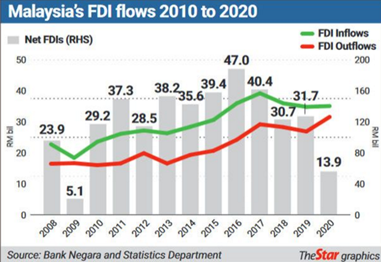
Other countries are not only bigger but are also growing faster than Malaysia, with more opportunities for investment. Less corruption, better education and a more welcoming environment will garner new investments. Malaysia is descending into irrelevance with net foreign direct investments (FDIs) to Malaysia falling since 2016. In fact, Malaysian companies are increasingly investing in other countries.


Malaysia needs value added investments in healthcare, the creative industries, leisure-based activities and those in AI and technology. The local R&D scene needs a fresh perspective. The target should be smaller companies that will actually create jobs, offer supply chain opportunities and promote long-term research and development for the country.

It will be useful for the Minister to re-evaluate Malaysia’s strategic positioning after discussing with MIDA and MITI officials. Please re-calibrate with some thought process rather than “off-the-cuff” remarks that remind us of the 70s and 80s.

References:
Zafrul’s “gateway” proposal gets the thumbs down, David Pillai, FMT, 27 Jan 2023

FDIs – more than meets the eye, Pankaj C Kumar, The Star, 27 Mar 2021

Friday, 3 February 2023

Cyberjaya: Malaysia’s Failed Silicon Valley?

Cyberjaya was once the pride of Malaysia, as it was to be the Multimedia Super Corridor’s (MSC) first intelligent digital city, commissioned by the Federal Government of Malaysia in the late 90s. While there have been major improvements to Cyberjaya, it isn’t exactly comparable to Silicon Valley in the United States. An article by Insider was recently published with the following view:

 “Cyberjaya, located just outside of the capital city, Kuala Lumpur, was once dubbed the Silicon Valley of Malaysia. But today, the city has been slammed as a failure by media outlets and think tanks.” This came after the author of the article had visited Cyberjaya late 2022 and reviewed a shipping container hotel there.

While more than 100,000 people live in the city, it doesn’t have the start-ups and big tech headquarters that its California counterpart does. Instead, it’s a place where satellite offices, and data and call centres are set up. Those who work at these places are said to be earning USD$365 (RM1,563.84) a month. Cyberjaya was described as a city with lush greenery, dead malls and a gated community where some of the city’s wealthiest people live.


Source: https://ms.wikipedia.org


In its journey to remain competitive as a Global Tech Hub, Cyberview Sdn Bhd was mandated by the Government to revitalise Cyberjaya through the introduction of a new masterplan in 2019. 

The company has also taken on the role of a tech hub developer which will see the integration of five key elements - facilities, community, activities, experience, and incentives. 

Nevertheless, Cyberjaya has the highest concentration of tech companies, talent and creators in Malaysia owing to its tech ecosystem. Apart from the multinationals (Dell, DHL, Huawei and others) the city has home-grown talents like Aerodyne, IX Telecom, Monsta and Wau Animation. 

The most recent significant entry is Microsoft, who will be developing its data centre with a total investment of USD4.6 billion in new revenues. Additionally, Microsoft and its partners are estimated to contribute more than 19,000 direct and indirect jobs. Microsoft’s presence in Cyberjaya is an encouraging development and certainly provides a boost for the new masterplan that will see the creation of three tech clusters within the South Innovation Zone.

From the total of developable land in Cyberjaya, 1,063 acres or 29% are still available for future development. Cyberjaya is the only location in Malaysia that offers developers attractive potentials that comes with enterprise land category. Enterprise land generally offers lower plot ratio, which provides a distinct advantage for developers in offering office spaces at competitive rates.

In 2017, the World Economic Forum named Bangalore the world’s most dynamic city, based on factors including innovation and technology. Bangalore, the capital of Karnataka is the favorite destination for IT job seekers. It is also known as the “Silicon Valley of India”. The original Silicon Valley, situated in the southern San Francisco Bay Area of California, is home to many start-ups and global technology companies like Apple, Facebook and Google.
Malaysia should learn from Bangalore’s success to become a second Silicon Valley. That’s according to DAP veteran Lim Kit Siang. Bangalore has the highest number of engineering colleges than any other city in the world. Karnataka is a prime centre of learning with 16 universities, 133 medical training institutions, 134 engineering colleges and 712 colleges. It is the ‘science centre’ of India with over 100 research and development centres and has become a hub for Startup culture.

So, is Cyberjaya a failed Silicon Valley? It has facilities, land, pleasing greenery and many homes for the wealthy. But that is not the ingredients for a tech or Silicon Valley. Bangalore is a good example to emulate – we need the ecosystem for top research universities in the sciences and engineering; hub centres for medicine, pharmaceuticals, IT, AI, robotics and the like; the ease of entry for foreigners in these areas and the pursuit of STEM education could provide jobs in Cyberjaya. The “drag” so far has been the “nationalistic” policies. Unfortunately, “real” tech valleys don’t recognise our blinkered views. Good luck Cyberjaya – look at people rather than physical facilities. Start-ups are owned by smart people, not smart buildings!

References:
Cyberjaya dubbed Malaysia’s failed Silicon Valley, Renushara, worldofbuzz.com, 24 January 2023

Cyberjaya: A tech city for all, Cynthia Ignatius, businesstoday.com, 28 Feb 2022

Reflecting on failed MSC plan, Kit Siang urges Malaysia to follow Bangalore’s lead, R. Loheswar, malaysia.news.yahoo.com, 6 Aug 2019

Thursday, 2 February 2023

Do We Need Tourists?

 In 3Q22, total passenger traffic was 15.6mn, the highest since the start of the pandemic. This improvement brings the 10M22 passenger traffic number to 42.2mn. The domestic traffic in the 3Q22 was equivalent to 71.3% of pre-pandemic levels whilst international traffic was 38.6% of pre-pandemic levels. The stark increase in the passenger traffic number was mainly supported by the full reopening of the Malaysian borders to international travellers on 1 April 2022. 

With more seats scheduled in the 4Q22, the total air passenger traffic for Malaysia in 2022 is now estimated to slightly outperform Malaysian Aviation Commission’s (MAVCOM’s) best-case scenario forecast. The 2022 air passenger traffic is expected to reach between 53.0mn and 55.0mn passengers, growing by 380% YoY to 400% YoY. MAVCOM forecasts Malaysia’s air passenger traffic in 2023 to increase by between 40% YoY and 52% YoY, translating to 74.6mn – 80.8mn passengers. International passenger traffic is expected to experience significant recovery, with routes to key markets gradually being restored beginning 4Q22. 


Source:https://focusmalaysia.my

In 3Q22, Malaysia’s cargo traffic recorded a growth of 12.2% YoY (3Q21: 23.6% YoY) to 5.5bn in 3Q22 (3Q21: 4.9bn). In the first three quarters of 2022, air cargo totalled 16.2bn FTK, with an average of 5.4bn FTK per quarter. For 2023, MAVCOM estimates Malaysia’s air cargo traffic to increase by between 3.0% YoY and 4.8% YoY, translating to 22.4bn – 22.8bn FTK. The expansion will be underpinned by the continued growth of e-commerce and the electrical and electronics (E&E) sector. However, persistent inflationary pressure, rising interest rates, and fear of a recession will be headwinds to watch out for. 

Malaysia is now the sixth-most connected country in ASEAN in 3Q22, while KUL is the fourth-most connected airport in ASEAN. Based on MAVCOM’s Air Connectivity Index, Malaysia’s ranking dropped from fourth to fifth since 2020, and is now down to sixth in 3Q22, with a connectivity score of 46.1. Despite offering more international seats and destinations, Malaysia was ranked lower than Vietnam and the Philippines due to having a higher percentage of international seats scheduled to low-weightage airports. Meanwhile, KUL was the fourth-most connected airport in ASEAN behind SIN, BKK, and MNL, recording a connectivity score of 35.8. Malaysia’s connectivity score was also adversely affected by China’s zero-COVID policy where only a limited number of slots were available to China. 

There are plus and minus points to the report:
-we have not reached 2019 levels;
-KUL has dropped in its ranking;
-Singapore, Bangkok and Manila are ahead of us in connectivity;
-impact of China tourists have not been accounted for or what needs to be done.

The Government is fully aware of the shortcomings but is there a will to change? Our front-liners are from a by-gone generation. They are difficult to genuine tourists, which deters others to come to Malaysia. Do we want tourists or otherwise?

Reference:
Malaysian Aviation Commission, Key highlights, Waypoint, December 2022